
Importing IT equipment into Brazil without customs delays.
What a global IT team needs to know before shipping laptops, servers or network gear to Brazil: who can import, which certifications apply, how taxes stack up and how long it really takes.
1. Who can import
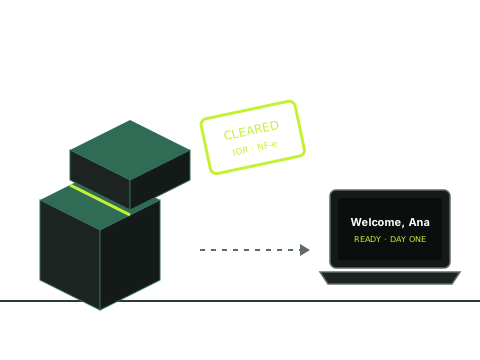
Imports into Brazil must be made by a company registered with the Federal Revenue Service for foreign trade (the RADAR enablement in Siscomex). If your company does not yet have a Brazilian entity, or its entity is not enabled for imports, an Importer of Record imports on your behalf and handles the fiscal obligations.
2. Product classification (NCM)
Every item is classified under the Mercosur Common Nomenclature (NCM). The classification determines import duty, other federal taxes and whether licences apply. Wrong classification is the most common cause of fines and delays.
3. Certification: Anatel
Equipment with radio or telecom functions — laptops with Wi-Fi or Bluetooth, phones, access points, routers — must carry Anatel certification for the specific model. Most mainstream models from major brands are already certified; check the exact model before you buy. Uncertified equipment can be held at customs.
4. Taxes: how they stack up
Import taxes in Brazil are cumulative: federal duties and contributions plus the state tax (ICMS), several of them calculated on top of each other. Depending on the product classification and destination state, the landed cost of IT hardware can be substantially higher than its purchase price. Ex-tarifário regimes can reduce duties for certain goods without a national equivalent.
Brazil’s consumption tax reform begins a phased transition in 2026, gradually replacing several of today’s taxes through 2033. Rates and rules will change during this period — confirm the current treatment with your Importer of Record or customs broker before each shipment.
5. Customs channels
After registration, each import declaration is assigned a channel: green (automatic release), yellow (document check), red (document and physical inspection) or grey (special valuation procedure). Complete, consistent documents are the best way to avoid red channel delays.
6. Used and refurbished equipment
Importing used equipment into Brazil faces strict restrictions and usually requires prior licensing. For refresh programmes, plan to source new equipment or buy locally.
7. Realistic lead times
| Step | Typical time |
|---|---|
| Classification, certification check, documents | 1–2 weeks |
| International freight (air) | 3–7 days |
| Customs clearance (green / yellow channel) | 2–10 business days |
| Staging and delivery | 3–7 business days |
Red channel inspections, missing certification or classification disputes can add weeks. Plan new-hire devices 6–8 weeks ahead, or keep a local buffer stock.
8. Checklist before you ship
- Importer identified (your enabled entity or an Importer of Record)
- NCM classification confirmed for every item
- Anatel certification confirmed for every model with radio functions
- Commercial invoice, packing list and airway bill consistent, with serial numbers
- Landed cost estimated per item and per destination state
- Delivery, staging and asset tagging planned
This guide is general information, not legal or tax advice. Rules change; confirm with a licensed customs broker.
Download the PDF: Importing IT equipment into Brazil
A printable, branded version to share with your project team. Includes the pre-shipment checklist and lead-time planner.
- Print-ready
- Link also sent to your inbox
- Free, no commitment
Can INconnet import for us?
Yes. We act as Importer of Record, stage the devices in São Paulo and deliver them ready to use.
Can employees carry laptops in their luggage?
Personal travel allowances are not designed for corporate equipment. For fleets, use a formal import.
Is it cheaper to buy locally?
Sometimes. We compare landed import cost with local purchase for each model.
Tell us what you’re planning. We’ll reply within 1 business hour.
- 01A solutions lead — not a call center — gets back to you.
- 02A 20-minute call to understand your sites and timeline.
- 03A coverage map and priced proposal within 3 business days.